
The Emperor's New Clothes
Taking a look at July FOMC and other events of note this week through the lens of the dangers of groupthink and powerful leaders with confirmation bias

The Emperor’s New Clothes is a children’s story which — like all fables — conveys several lessons about human nature and its potential pitfalls.
Some of its key lessons include how uncritical conformity/group think can create a collective illusion and the dangers of powerful, isolated leaders with confirmation bias.
Heading into July FOMC, there had been a disturbing level of spin leading to groupthink around the new Warsh Fed as Greenspan 2.0.
This M-FAB post questioned this spin headed into July FOMC.
As also noted in a prior M-FAB post, headed into the July meeting the FOMC had to pick whether it cared about:
upsetting the front-end of the Treasury curve (July rate hike not fully priced in);
or
the back-end of the Treasury curve (Taylor rule suggests inflation at risk of moving even further above target, tough talk from new Fed Chair Warsh not matched by action).
Whether all FOMC members recognized it or not, this meeting the majority of the Committee by supporting no rate hike prioritized maintaining stability at the short-end of the Treasury curve as opposed to long-dated Treasury yields.
The July FOMC decision, in my view, maintains pressure on the US AI cap-ex trade which is financed with long-term debt. As I noted previously, with the AI cap-ex trade rolling over, the risk is rising that the end of the credit and macroeconomic cycle is starting to come into view.
I have increased my personal allocation to cash. Time will tell and am thrilled to be wrong.
The July FOMC ended with three regional Reserve Bank presidents dissenting. These dissents could not have been a surprise to new Fed Chair Warsh. It increases the potential that the unkind “sock puppet” comment from his Senate confirmation hearing sticks. Yet, he left rates unchanged — prioritizing the front-end of the Treasury curve — a topic that I will return to later.
As noted in a prior post, Warsh’s confirmation testimony comment that “inflation is a choice” seemed assured to come back to haunt him. It is easy to conclude that is the sole issue and that it now has. Tough talk and no change in policy result certainly fosters an image that he, as the Texas saying goes, is “all hat and no cattle.”
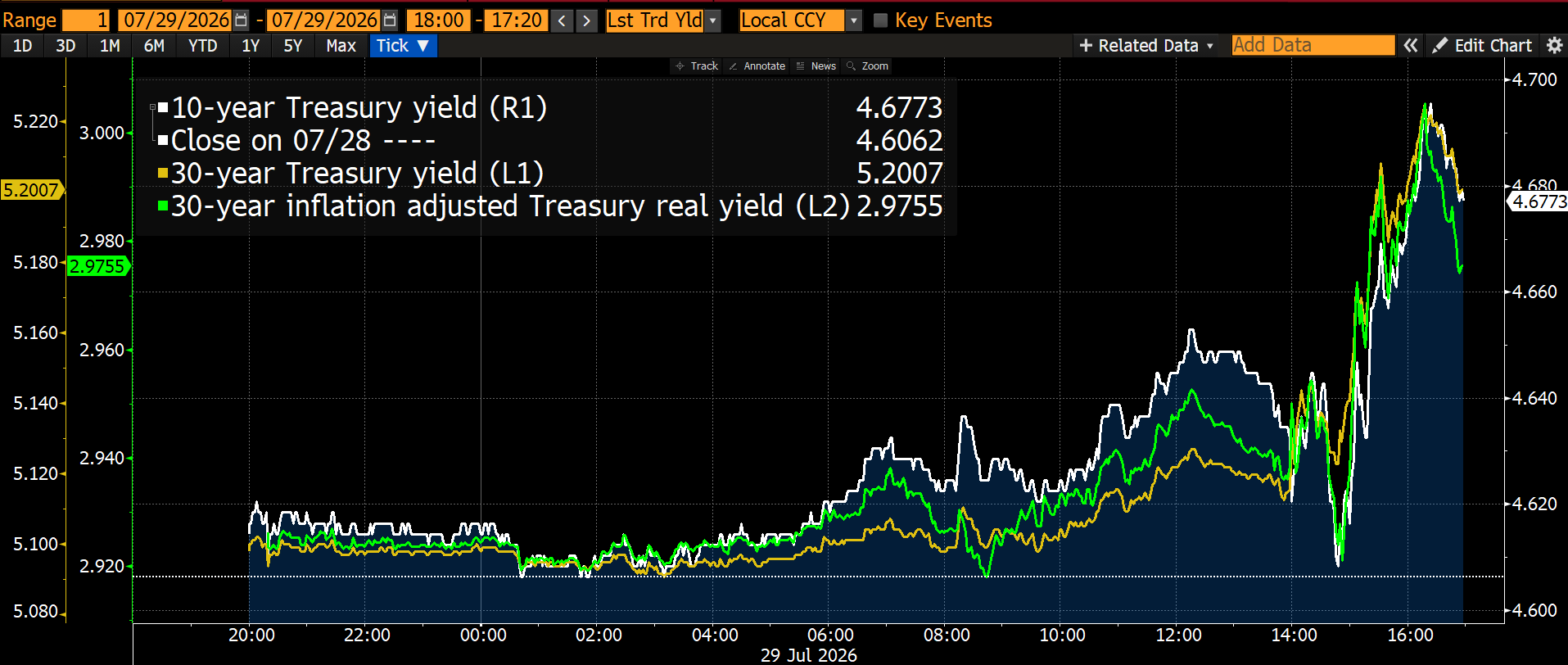
However, as can be seen below, long-dated Treasury yields did not react extremely poorly to the FOMC decision being announced at 2 pm ET or to a specific moment in Warsh’s press conference itself.
Was the move in long-term Treasury yields solely about the FOMC not raising rates in July? The decision itself certainly had some impact, but more impactful was listening to the press conference in totality.
I was driving home from giving a talk in Fort Worth and listened to the press conference in the car. Three aspects to Warsh’s remarks that struck me as most notable and likely to pressure long-dated Treasury yields to rise were:
First, Warsh declined to clearly explain his reaction function while signaling that the taskforces imply change to how US inflation is measured and perhaps also the Fed’s inflation target.
“Yeah. So I’ll give two answers. First, let me give the proper standard answer. The Federal Reserve every January outlines a statement of purposes and strategy. And in that strategy document, which I believe was dated January of this year, it describes a measure of PCE inflation as the objective function there. I have enough of my own – so that’s our number. We’re sticking with it. Who knows come after next January what we might say about strategy. I suspect the task forces might have something to add.
But I’ll say this, some version of the Lucas critique, some version of Goodhart’s law in economics should remind us that when we talk about measures of inflation, or something else, and we describe those measures as being consistent with our objectives, we might make them such that they’re not very good measures or very good objectives.
Second, Warsh offered a highly questionable interpretation of the rise in long-dated Treasury yields, particularly TIPS’ real yields, as reflecting market expectations of strong US economic growth. A peek at Bloomberg shows that consensus forecasts do not call for an acceleration in US economic growth. How is he reaching this conclusion?
Warsh stated also that “market participants are learning to play ball, not the referee” as he attributed the recent sharp rise in real yields to investors responding to real economic data rather than Fed guidance. It seemed a powerful example of a leader displaying confirmation bias.
But what if the rise in TIPS’ real yields and nominal Treasury yields is not entirely about US growth expectations? What if the Fed chair’s own communications about the creation of the five taskforces are responsible for a meaningful portion of the move higher in long-term US interest rates?
Specifically, Chair Warsh appeared concerningly unaware that his own statements about several of the new taskforces may be exerting upward pressure on long-dated Treasury yields. I hope to have a piece out on the taskforces as Warsh’s own unique form of forward guidance coming out early this week.
Third, it is possible to wonder briefly whether Warsh may be trying to execute a subtle plan to tighten US financial conditions through long-dated Treasury yields. If so, this would be a bad plan because it would likely embed a lasting risk premia in US financial markets relative to tightening policy through short-term interest rates.
However, Warsh’s press conference remarks do not inspire confidence that there is a strategy.
Specifically, his remarks seemed to indicate that he no significant strategy for the Fed beyond the five taskforces. For example, when asked about his plan for the Fed’s upcoming August Jackson Hole conference, he stated “I look at it [my Jackson Hole remarks] like a blank piece of paper right now. I have not begun consideration with the incredible team here what would go into that document. Historically, at least from my first tour of duty at the Fed to more recent periods, it would be sort of a setting-up speech more often than not of what was going to be happening in the fall. I haven’t made any judgments on that, but those are judgments we’ll have to come to. If I could, in the high mountain air in Jackson, Wyoming, I’d like to also frame the big questions. There is a tendency, especially with the proliferation of meetings and press conferences, to get caught up in the myopic: Did you do this by a quarter, or do that? Haven’t made the decision whether it’s going to be a big-picture speech or whether it’s going to be a more traditional setup for all the action we’re going to have between September and December. I will tell you one other thing that I am doing between now and Jackson Hole, which is I’m checking with those task forces.”
Chair Warsh referred to the new taskforces eight times in the press conference. For now, the taskforces appear to encompass his forward guidance.
On balance, the Warsh taskforces point to higher long-term US interest rates (my forthcoming piece early this week lays out these arguments) but I think taskforces as forward guidance and a Fed chair who doesn’t see the bond market still acting as a mirror to him and the Fed were significant takeaways for me.
So why might Warsh and the majority of the FOMC prioritize keeping short-end rates low?